Category: White Ceramic Jewelry

  • Imaginative ways to create the perfect play area

    The Benefits of Play

    Research from the NHS has found that exercise and fresh air can significantly improve your mental health. In a study conducted by the University of Essex, it was discovered that exercising outdoors was associated with improvements in both self-esteem and mood. With the rise in technology, it is becoming even more important to encourage children to play outdoors.

    Sensory play is just as important as outdoor play. Sensory activities at a young age allow children to explore and investigate. It has been discovered that sensory play helps to develop nerve connections in the brain, as well as the development of speech and motor skills.

    By creating a safe and vibrant space in your home, you can help to teach your child vital skills which they’ll carry with them through life.
  • tips for artificial grass maintenance

    Artificial grass is the perfect way to enhance your outdoor lifestyle. Not only does it look fantastic, but is also excellent value for money, safe for children and pets and requires less maintenance than natural grass.

    With artificial grass, your Sunday afternoons can be spent doing the things you love most, rather than spending time keeping your lawn in check.

    Although artificial grass is low-maintenance and comes with all of these benefits, you’ll still have to do a couple of things to keep it in good condition and to improve its lifespan.

    To keep your grass looking its best all year round, follow these tips from our experts.

    Brush it

    Brushing your artificial grass will help to keep the fibres upright and looking as natural as possible. We recommend having a bi-weekly artificial grass maintenance brushing routine to keep your lawn looking as good as new. It is important to firmly brush against the fibres with a garden brush and sweep away from yourself. We would also recommend removing debris such as leaves, twigs and sticks, as these could build up and attract insects.

    Rinse it

    Rinsing your artificial grass should be a key part of your turf maintenance routine. Use a hose to rinse away any loose debris. The water should be cold and on a low pressure, so that the grass isn’t damaged. Start at one end of the garden and slowly move across, using circular motions. Ensure that the artificial grass is left to dry to avoid any accidents.

    Disinfect it

    Disinfecting your artificial grass will keep any bacteria at bay. You should disinfect the turf with a mild detergent once per month. You can keep it clean with our artificial grass cleaner. Animal waste should be removed daily to ensure that the grass doesn’t become dirty or stained.

  • What’s the difference between Polyurethane and latex?

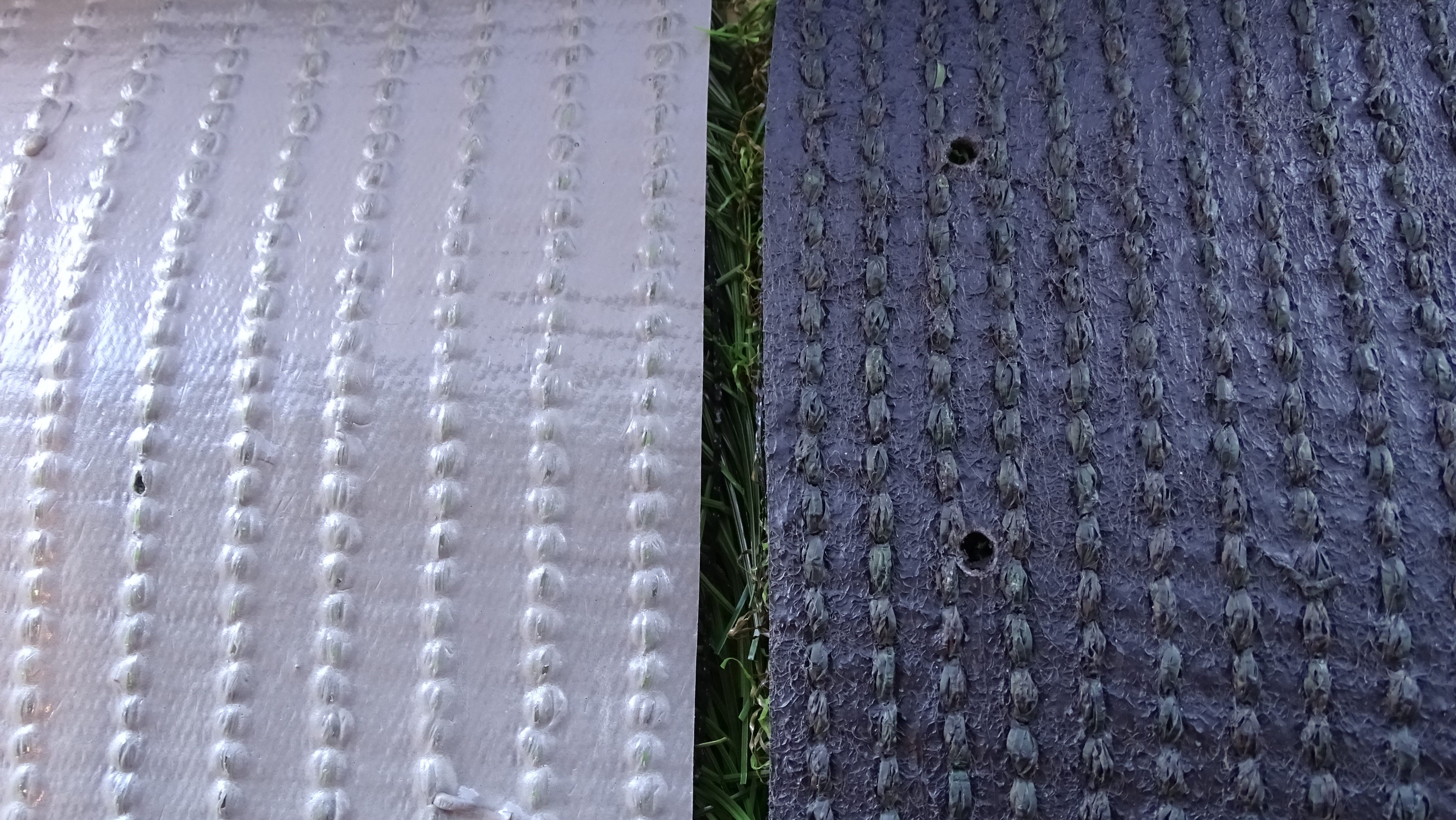
    PU vs Latex

    PU (left) and Latex (right).

    Latex is a popular coating used by most grass providers on the market and is a strong and reliable choice. However, at BuzzGrass we are always innovating, and the use of PU on our premium products means that our grass will be stronger and have greater resistance to moisture, which makes it the perfect product for families with children and pets.

    Benefits of PU
    • More durable – the turf will have better fibre retention and stronger backing, which is great if your dog likes to dig in the garden
    • Designed in the UK at our HQ – this ensures a quality product that lasts for 10 years
    • Better drainage – because PU is lightweight and water-resistant, liquids can easily drain through your grass which makes it quick and easy to clean
    • Easier installation – PU is thinner than latex, which makes it easier to cut and install
    Better for pet owners

    Maintaining a healthy lawn is almost impossible for pet owners. Animals, especially dogs, can cause havoc in gardens with natural grass, by digging holes, bringing mud indoors and also leaving urine stains. Installed in countless gardens and doggy daycares around the UK, our artificial grass for dogs has been proven to stand the test of time, and now with our new PU products, the grass is even more durable!

  • Introducing Our New Polyurethane PU backed Artificial Grass

    BuzzGrass is proud to announce that some of our products will now have a Polyurethane (PU) backing, rather than a traditional latex backing.

    Our grass is backed in the UK at our Maryport factory, which is one of the most technologically-advanced production facilities in Europe, using the same innovative technology as our sister company, SIS Pitches who work with some of the biggest names in sport.

    The following products will now have PU backing:

    • Luxe
    • Elite
    • Essential
    • Lush
  • Type of Irrigation System 

    Are sprinklers a waste of water? The truth is that sprinkler irrigation systems are not as efficient at water conservation as they may first appear. The typical water consumption for a residential sprinkler system ranges from 12 to 30 gallons per minute, depending on the sprinkler head’s size and type. Operating the sprinkler for 30 minutes a day, 15 days a month, can lead to a consumption of up to 450 gallons per month. 

    Inadequate water pressure and strong winds can cause significant water loss due to drift or evaporation.  

    Rate Type 

    Understanding your monthly water bill is the first step to determining the costs of watering your lawn. The bill measures your water usage using various standard units of consumption, the most common being centum cubic feet (CCF) and gallons, where 1 CCF equals 748 gallons. 

    The local water utility employs a range of rate structures to bill its customers, including:  

    • Uniform Rate structure: Charges a constant per-unit price for all metered units of water consumed throughout the year. 
    • Increasing Block Rates: Charges higher unit rates for each succeeding block of usage than the previous block(s). 
    • Seasonal Rates: Established to promote conservation during peak usage periods and cover a specific time frame.  
    • Drought Rates: Similar to Seasonal Rates, these rates depend on the level of drought in the local area, rather than applying higher rates throughout a particular period. 

    All these rate structures can substantially increase water bills if you regularly water your lawn.  

  • What can increase your water bill above the average?

    Type of Grass
    How the type of grass in your lawn affects your water billTwo types of grass are commonly used for residential lawns – Cool Season grasses and Warm Season grasses. Cool Season grasses can withstand colder temperatures and will go dormant in hot, dry weather. Examples of this type of grass include Ryegrass, Fine and Tall Fescue, Creeping Bentgrass, and Kentucky Bluegrass. 

    On the other hand, Warm Season grasses thrive in warmer climates, such as the southern regions of the U.S. They experience the most growth during the warmest part of the year. These types of turfgrass often require less water than Cool Season grasses. Examples include Bermuda grass, Zoysia grass, St. Augustine grass, Bahia grass, Buffalo grass, and Centipede grass. 

  • How to Remove Infill With A Forklift

    How to Remove with a Truck
    You can easily remove infill by tying one end of a rope to the edge of your roll and the other to a car or truck. Drive slowly forward until your turf is unrolled and the infill falls out, and then shake out the remaining infill.

    How to Remove Infill With A Forklift
    If you have access to a forklift, you can use it to lift a section of your turf roll about four feet off the ground and then hit it with a broom to shake the infill out. You would then repeat this process for the entire length of the roll.

    Note: This process is only recommended if you’re skilled in the operation of a forklift. Do not attempt if you are not able to comfortably operate a forklift.

    For more detailed instructions on DIY Extraction, check out this article!

  • Types of Repurposed Turf

    Extracted Turf
    Like most repurposed turf, extracted turf is sourced from local sports fields. Unlike infilled turf, extracted turf has had the infill professionally removed for a lighter, easier to install product.

    Without infill turf is only about half a pound per square foot, making it easier to work with. However, infill is absolutely necessary to the look, performance, and life of your turf. So if you do purchase extracted turf, you’ll still need to buy infill and add it to your turf

    Because extracted turf is infill-free, you have the option to buy a higher quality infill than the sand and crumb rubber commonly found in infilled sports turf. High quality infills like ZeoFill can keep your lawn up to 20 °F cooler and also prevent the growth of harmful microbes.

    Infill
    Infilled turf comes with infill already in it. It’s less expensive than extracted turf and also saves you the cost of purchasing infill. However, infill adds A LOT of weight to the product, which can make transportation and installation more difficult.

    Limiting factors for infilled turf include manpower, access to your project site, and your ability to transport heavy loads.

    Lucky for you, there are more than a couple ways to remove infill from turf yourself! These DIY extraction methods help you quickly and effectively remove the infill:

  • Not Safe for Pets

    While some people believe artificial grass is not suitable for pets, it is actually not the case. In fact, it is safer than natural grass. To understand this better, here are some points to consider.

    Durability:

    Artificial grass lasts significantly longer than real grass. If your pets like rough play, they will most likely create large holes and patches in your natural grass. With artificial grass, however, no matter how often they rip about the lawn, it will always look immaculate.

    Cleanliness:

    Synthetic grass, unlike natural grass, does not become muddy in the winter. This means you won’t have to worry about scrubbing muddy paw prints off the floor if your dog runs inside suddenly.

    Grass Length:

    If you don’t mow your natural lawn too often, the overgrown grass can be frightening to a little animal, but with an artificial lawn, the grass will always be at the proper height. It is also comfy and soft for pets to rest on, creating an enticing outside place for them.

    Free of Toxins:

    When it comes to animals nibbling on the grass, artificial grass may be safer than natural grass. This is because there is no need to apply fertilizers, pesticides, or weed killers on an artificial lawn to keep it looking great. So you don’t have to be concerned about your pet ingesting something toxic.

  • Artificial Grass is Expensive

    One common misconception about synthetic yards is that it is prohibitively costly. However, an artificial lawn may be extremely cost-effective in the long run, even costing less than natural grass.

    When you factor in the cost of lawnmowers, grass feed, fertilizers, pesticides, hoses, water usage, strimmers, and re-turfing required to keep a real lawn looking good, artificial grass is far less expensive than real grass over its entire lifespan because it does not require any of the above to keep it looking good.

    So, while artificial grass is more expensive to install, the savings in time, effort, and money spent on upkeep might save you several thousand bucks in the long term, indicating that an artificial lawn can be more cost-effective than a genuine lawn.